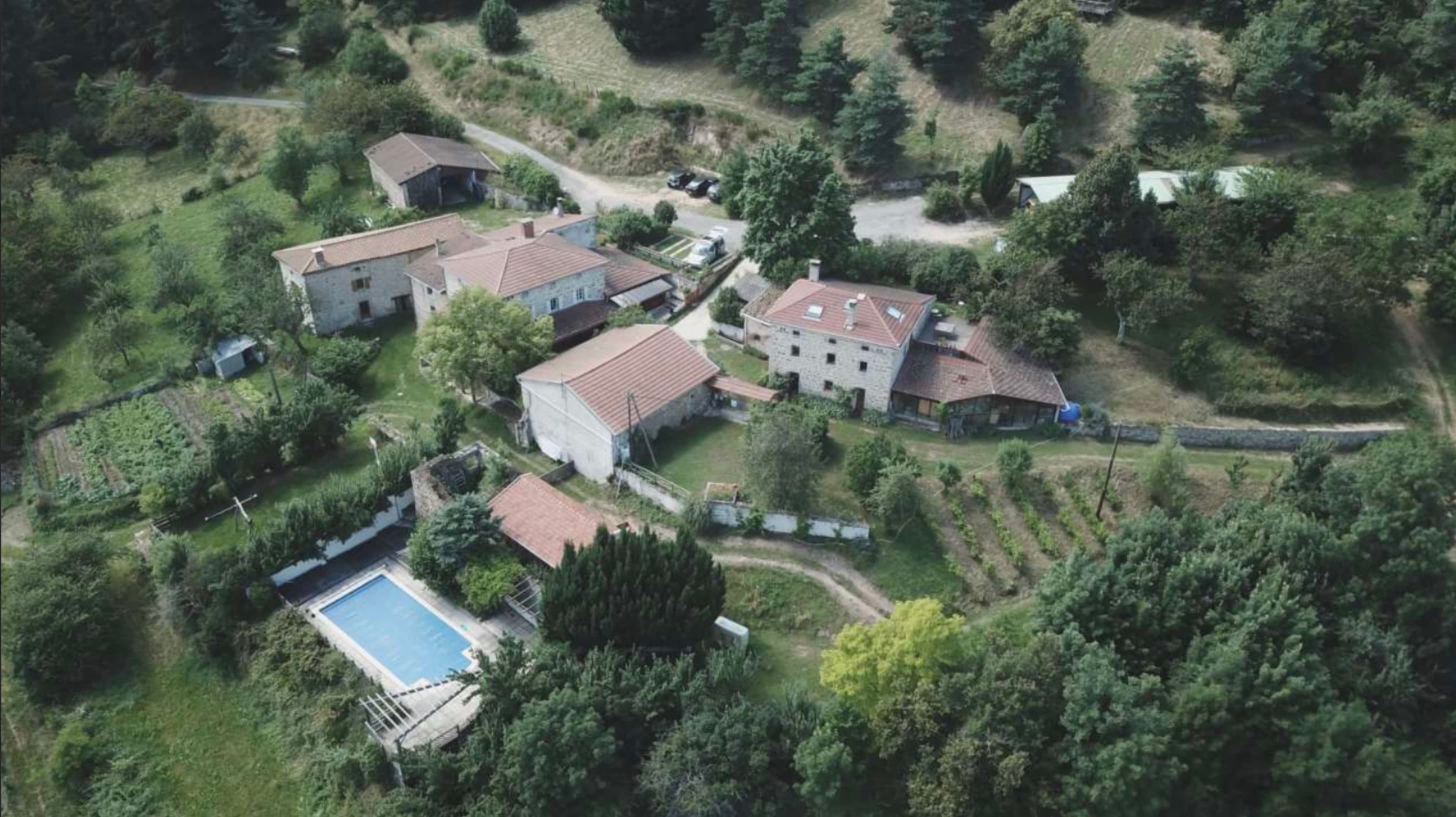
The Garden
14 hectares of living nature in the Ardèche
The playground
14 hectares of living nature: dense woodland, a generous orchard, wild meadows — and a mandala vegetable garden taking shape. An estate where biodiversity thrives season after season.
14 ha
total
10 ha
woodland
1 ha
orchard
The forest
Ten hectares of mixed forest surround the property, providing shade and coolness even in the height of summer. Winding paths invite you to walk, observe wildlife and forage for seasonal mushrooms, berries and wild plants. An invitation to slow down and reconnect with the living world.
The orchard
One hectare of fruit trees planted using permaculture principles, yielding an abundant harvest from spring through autumn. Some fruits are available in season for guests.
The Mandala Garden
What is permaculture?
Permaculture — a contraction of "permanent agriculture" — is an approach to designing sustainable systems inspired by natural ecosystems. More than a gardening technique, it is a design philosophy that aims to create productive, resilient and self-sufficient environments.
Care for the Earth
Regenerate soils, preserve biodiversity, conserve natural resources.
Care for people
Grow healthy food, create spaces of well-being and connection.
Fair share
Redistribute surpluses, share knowledge and make it accessible.
Design overview
16 × 12 m
ellipse
12
growing petals
70 m²
growing area
1
central pond
2
ducks
3
composting zones
How this design applies permaculture
Collect and store energy
The central pond stores rainwater and regulates temperature (thermal mass). Lasagne beds store water and nutrients in their organic matter.
Apply self-regulation
Ducks naturally regulate slug and snail populations. No intervention needed — the system balances itself.
Produce no waste
Closed loop: green waste → compost → beds → vegetables → peelings → compost. Dead leaves, chipped wood, cardboard — everything becomes a resource.
Integrate rather than segregate
Every element serves multiple functions. The pond: water reservoir, duck habitat, thermal mass, irrigation, aesthetics. The ducks: slug control, fertilisation, animation, eggs.
Use and value diversity
12 petals = 12 slightly different microclimates. Polyculture and companion planting, not monoculture. Flowers for pollinators, habitat for beneficial insects.
Value edges — the edge effect
In ecology, the edges between two environments are the richest zones. A square garden has 4 edges; the mandala creates 24+. More interfaces = more biodiversity = more resilience.
The overflow irrigation system
Rainwater feeds the pond, ducks enrich it, and the overflow irrigates the petals by gravity alone. A concrete example of permaculture principles in action.
Rain → Pond → Ducks enrich the water → Overflow
↓
Gravity channels → South petals
↓
Irrigation + natural fertilisation
No pump. No inputs. No effort.
Lasagne beds
Each petal is built up in successive layers. As they decompose, these layers create a living soil, rich in humus, that retains water and nourishes plants over the long term.
An ecosystem, not just a vegetable garden
Ducks feed the plants. Plants feed people. People feed the compost. Compost feeds the soil. Soil feeds the plants. A circle. A mandala. A living system.
This garden is under construction at Saint-Symphorien-de-Mahun, in Ardèche.
14 hectares of living nature in the Ardèche
Book Now